




Best Mattress for Sleep: Memory Foam vs Pocket Sprung vs Hybrid Mattress Comparison

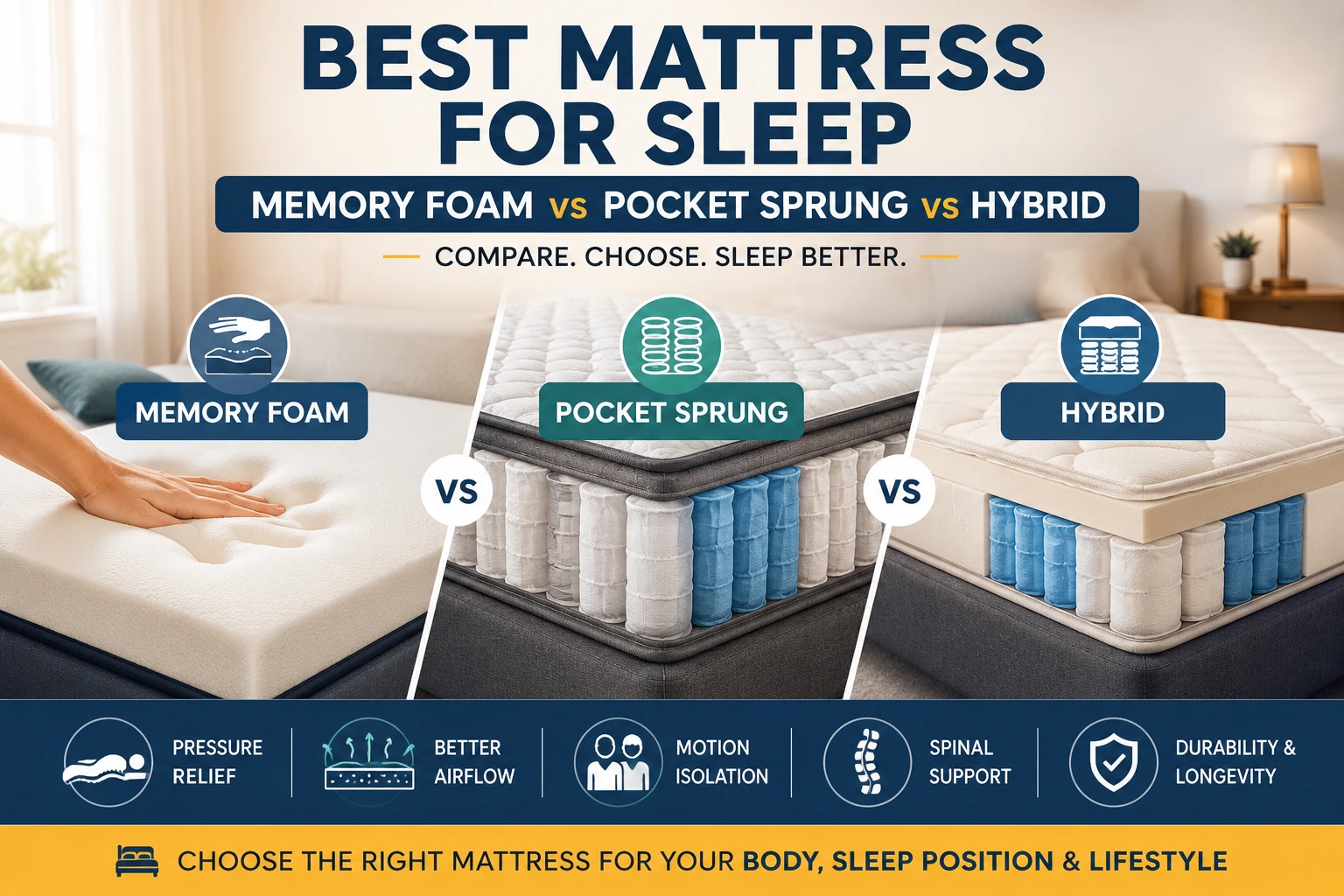
What Is the Best Mattress for Sleep – Memory Foam, Pocket Sprung, or Hybrid?
The best mattress for sleep matches three factors: sleep position, body weight, and how warm you sleep at night. Memory foam suits side sleepers who want deep pressure relief and quiet motion isolation. Pocket sprung mattresses suit back and stomach sleepers who want a bouncier, cooler surface. Hybrid mattresses combine both layers, making them a low-risk pick for couples or mixed sleep positions.
NASA-funded research produced viscoelastic memory foam in 1966 for aircraft seat cushioning. Harvard Health reports that more than 60% of adults sleep on their side, based on Sleep Foundation data (Harvard Health, 2025). Back pain is one of the most common reasons shoppers replace a mattress. This guide compares memory foam, pocket sprung, and hybrid mattresses directly, then matches each type to sleep position, back pain, and support needs.
Table of Contents
- What Is a Memory Foam Mattress and What Are the Key Benefits of Using One?
- What Is a Pocket Sprung Mattress and What Are Its Benefits?
- What Is a Hybrid Mattress and What Benefits Should You Know About?
- Hybrid vs Memory Foam Mattress: Which Offers Better Pressure Relief?
- Pocket Sprung vs Memory Foam: Full Comparison Table
- What Is the Best Mattress for Side Sleepers?
- What Is the Best Mattress for Back Pain?
- What Does Mattress Support Mean?
- How Do You Choose the Best Mattress for Your Home?
- Frequently Asked Questions
- Key Takeaways
- Final Thoughts
What Is a Memory Foam Mattress and What Are the Key Benefits of Using One?
A memory foam mattress uses viscoelastic foam layers that soften with body heat and mould to the sleeper’s shape. Developed during NASA-backed research in 1966 for aircraft seating applications, memory foam eventually became a household sleep material. Tempur-Pedic commercialized the technology by releasing the first memory foam mattress in 1991.
The memory foam mattress benefits include:
- Conforms to the body’s natural curves, helping minimize pressure at the shoulders and hips.
- Strong motion isolation, so a restless partner doesn’t disturb sleep
- Operates quietly without metal springs that can create noise over time.
- Extra cushioning at the joints for side sleepers
Traditional memory foam can retain warmth, while newer gel-infused and open-cell foam technologies help dissipate heat more effectively. Memory foam is commonly available in densities between 3 and 5 pounds per cubic foot. Higher-density foam recovers more slowly and offers deeper contouring at the shoulder and hip. Memory foam works best for side sleepers who want a still, quiet mattress that isolates motion from a partner.
What Is a Pocket Sprung Mattress and What Are Its Benefits?
A pocket sprung mattress contains individually wrapped coils, often more than 1,000 per mattress. James Marshall patented the pocket spring design in 1899. Each spring compresses on its own, so the mattress responds to body shape without pulling down the surrounding surface.
The pocket sprung mattress benefits include:
- Strong airflow between coils for a cooler sleep surface
- Quick spring response for a bouncier feel
- Solid edge support for sitting on the bed’s side
- Better motion-transfer control than older open-coil systems
Pocket sprung mattresses typically last 7 to 10 years. Coil counts commonly range from 800 to 2,000 per mattress, with higher counts generally improving support precision. Individually wrapped coils also reduce squeaking, since each coil moves without rubbing against its neighbors. They feel firmer than foam, which can leave pressure points at the shoulder for side sleepers. Back and stomach sleepers, along with hot sleepers, generally get the most benefit from a pocket sprung design.
What Is a Hybrid Mattress and What Benefits Should You Know About?
A hybrid mattress layers foam or latex over a base of pocket springs. Brands such as Saatva and Purple both offer hybrid models built on this combined structure.
The hybrid mattress benefits include:
- Foam-level pressure relief paired with spring-level airflow
- Balanced support across most body weights and sleep styles
- A practical middle ground for couples with different sleep positions
- Lower heat retention than all-foam designs
Hybrid mattresses typically combine 6 to 8 inches of pocket springs with 2 to 4 inches of foam on top. Many hybrid designs add a thin transition foam layer between the springs and the comfort layer to smooth the surface feel. Hybrid mattresses generally cost more than single-material designs because of the combined build. Quality varies between brands, so coil count and foam density matter more than the label “hybrid” alone.
Hybrid vs Memory Foam Mattress: Which Offers Better Pressure Relief?
The main difference lies in balancing pressure relief with airflow. Tempur-Pedic remains a well-known all-foam brand; Saatva and Purple are established names in the hybrid category. Memory foam mattresses typically weigh less than hybrid models built on a steel coil base, which makes them easier to rotate, move, or ship compressed in a box. Hybrid mattresses are harder to compress for shipping because of the coil layer, so most hybrid brands deliver them rolled but still heavier overall. The following table compares the performance of each mattress type across key features.

Pocket Sprung vs Memory Foam: Full Comparison Table
This comparison highlights clear differences in bounce, temperature, and edge support. Pocket sprung mattresses generally cost less than premium memory foam models at equivalent quality tiers, though prices vary widely by coil count and finish. Memory foam mattresses are compressed and rolled in a box, while pocket sprung mattresses usually require standard delivery because of the coil structure. The table below places the two side by side.

What Is the Best Mattress for Side Sleepers?
The best mattress for side sleepers is a soft-to-medium memory foam mattress, or a hybrid with a thick foam comfort layer. Side sleepers make up more than 60% of adults, according to Sleep Foundation data (Harvard Health, 2025). Firmness recommendations for side sleepers generally fall between 4 and 6 on a 10-point firmness scale. Lighter body weights suit the softer end of that range, while heavier body weights need slightly firmer support underneath.
Key points for side sleepers:
- Side sleepers carry most of their body weight on the shoulder and hip.
- A mattress that is too firm creates pressure points at these two areas, which can cause numbness overnight.
- A best soft mattress for side sleepers still needs support underneath – too much sink causes the hips to drop lower than the shoulders and twist the spine.
- Casper markets its original mattress with layered foam designed to cushion the shoulder and hip.
What Is the Best Mattress for Back Pain?
The best mattress for back pain is a medium-firm design, not the firmest option available.
Key points on back pain and mattress firmness:
- Kovacs et al. published a randomized, double-blind clinical trial in The Lancet in 2003.
- The trial found medium-firm mattresses reduced daytime low-back pain more than firm mattresses.
- Global Burden of Disease data published in The Lancet Rheumatology in 2023 counted 619 million people living with low back pain worldwide in 2020.
- The best mattress for lower back pain combines a hybrid or pocket sprung base for spinal alignment with enough foam on top to relieve pressure.
- Mattresses older than 8 years lose support and often contribute to morning stiffness.
- Consistent support across the full mattress surface matters more than firmness rating alone for lower back pain relief.
- Stomach sleeping without adequate support can arch the lower back, which worsens pain regardless of mattress type.
What Does Mattress Support Mean?
Mattress support is different from firmness. Firmness is how the mattress feels on first touch – soft, medium, or firm. Support is how well the mattress keeps the spine in a neutral line regardless of firmness level.
A mattress can feel plush and still deliver strong mattress support if the core layer holds the body correctly. Support cores typically use 13- to 15-gauge steel coils or high-density foam rated above 4 lb per cubic foot. Core layers include:
- Pocket springs
- High-density foam
- A reinforced hybrid base
Heavier bodies need deeper support layers to avoid sinking through to the base of the mattress. Support ratings on product listings often use a separate 1 to 10 scale from the firmness scale, since the two measure different things. Edge support matters most for anyone who shares the bed or sits on its edge often.
How Do You Choose the Best Mattress for Your Home?
Choosing the best mattress for sleep starts with matching sleep position first, then adjusting for firmness and body weight. The best mattress pairs with a supportive bed frame and a properly ventilated bedroom setup for long-term comfort.
Practical buying checklist:
- Match the mattress to sleep position first, then adjust for firmness and body weight
- Test edge support if two people share the bed, since weak edges shorten the usable sleeping surface over time.
- Pair the mattress with a well-built platform or slatted bed frame – brands such as IKEA and Saatva sell frames rated for specific mattress weights, since frame quality affects airflow and mattress lifespan.
- Check the warranty and trial period – reputable retailers typically offer a 10-year warranty and a home trial between 30 and 100 nights.
- Read verified customer reviews for edge support and long-term sagging before buying, since these issues often surface after the first year.
- Pair the mattress with a matching bedroom set – nightstands and wardrobes included – for a more cohesive, comfortable bedroom setup.
Key Takeaways
- Memory foam suits side sleepers who want deep contouring, motion isolation, and a quiet surface.
- Pocket sprung suits back and stomach sleepers who want bounce, airflow, and a cooler surface.
- Hybrid mattresses suit couples and mixed sleep positions by combining foam comfort with spring support.
- A medium-firm mattress, not the firmest option, reduces low back pain the most (Kovacs et al., The Lancet, 2003).
- Support and firmness are different – a soft mattress can still offer strong support if the core layer holds the body correctly.
- Matching mattress type to sleep position, body weight, and heat sensitivity matters more than chasing the highest price point.
- Coil count and foam density matter more than marketing labels like “hybrid” when comparing build quality.
- A home trial of 30 to 100 nights remains the most reliable way to confirm comfort before committing to a mattress.
- Checking edge support matters most for couples and anyone who regularly sits on the side of the bed.
Final Thoughts
Memory foam, pocket sprung, and hybrid mattresses each solve a different sleep problem rather than competing on quality alone. Choosing between them comes down to sleep position, body weight, and heat sensitivity, not the highest price tag on the showroom floor.
Side sleepers generally get the most relief from a soft-to-medium memory foam mattress or a foam-forward hybrid, since both cushion the shoulder and hip. Back and stomach sleepers usually do better on a pocket sprung or hybrid design, since both offer firmer, more responsive support. Anyone dealing with back pain should prioritize a medium-firm design with consistent support, since clinical research links this combination to less daytime and overnight pain.
Testing edge support, checking the warranty length, and using the full home trial period all matter as much as the mattress material itself. A well-matched mattress paired with a supportive bed frame is what actually delivers a good night’s sleep over the years the mattress is in use.
If you’re ready to pair your new mattress with a frame and bedroom set that matches it in quality and support, browse the collection at Designer Furniture Gallery. Their range of bed frames, nightstands, and bedroom furniture is built to complement the mattress types covered in this guide — helping you get proper airflow, edge stability, and long-term durability from your full sleep setup, not just the mattress alone.
Frequently Asked Questions
1.What is the best mattress for sleep overall?
The best mattress for sleep overall is a medium-firm hybrid mattress with a supportive base. It suits most sleep positions and body types by combining a foam comfort layer with pocket-spring airflow and edge support.
2.Which is better, hybrid or memory foam?
Hybrid mattresses offer better breathability; memory foam offers more isolated pressure relief. The right choice depends on sleep position and heat sensitivity, not a single universal winner.
3.How does pocket sprung compare to memory foam for back pain?
Pocket sprung offers firmer spinal alignment while memory foam offers deeper cushioning. A hybrid mattress combines both benefits for most back pain cases.
4.What are the main types of mattresses available today?
The main types of mattresses available today are memory foam, pocket sprung, and hybrid designs. Latex mattresses also exist as a fourth category, though they appear less often in most retail ranges.
5.Do hybrid mattresses sleep hot?
Hybrid mattresses sleep cooler than all-foam designs because the spring layer underneath allows airflow. Exact temperature still depends on the type of foam used in the comfort layer.
6.How long do memory foam mattresses last compared to pocket sprung?
Memory foam mattresses typically last 6 to 8 years. Pocket sprung and hybrid mattresses typically last 7 to 10 years, depending on quality and usage.
7.Is a firmer mattress always better for back pain?
No. Kovacs et al. found in a 2003 Lancet trial that medium-firm mattresses reduced low back pain more than firm mattresses did.
8.Which mattress is the best mattress for couples with different sleep positions?
A hybrid mattress is generally the best mattress for couples with different sleep positions. It offers contouring for a side sleeper and responsiveness for a back or stomach sleeper on the same bed.