



Buying Furniture Online vs In Store: Which Is Better in the UK?

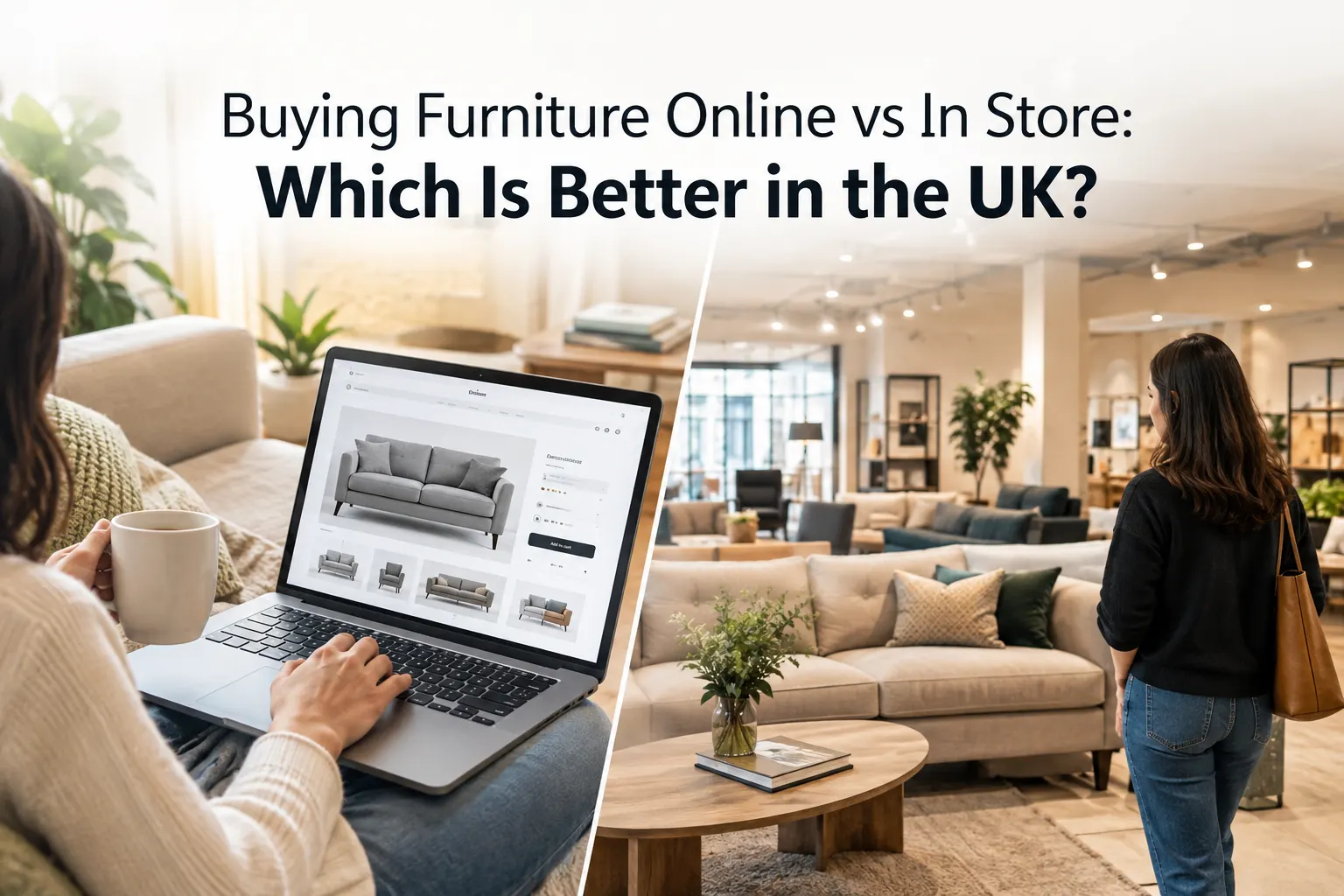
Should you buy furniture online or in a shop? Neither wins every time. Online gives you more choice and easy price checks. A shop lets you sit on the sofa, see the real colour and talk to a person.
For things you sit or sleep on, like sofas, mattresses and dining chairs, most people do both. They research online, then test the comfort in person. For tables, storage and lighting, online furniture shopping UK buyers rely on is usually a safe route.
So which is better when it comes to buying furniture online vs in store? It depends on what you need to feel, and what you can judge from a spec sheet. Furniture is a big purchase, so the answer changes with the piece.
This guide covers the real differences, your rights, how to measure, and what to check before you pay.
Online vs in-store furniture shopping: quick comparison

What are the advantages of buying furniture online in the UK?
Online shopping suits people who already know roughly what they want.
- More choices. Online furniture retailers UK-wide can show far more styles, sizes and fabrics than any showroom can hold.
- Easy comparison. Set price, materials and delivery times side by side.
- Clear specifications. Good product pages list dimensions, frame material and care instructions.
- At your own pace. No pressure. You can leave a basket for a few days.
- Specialist brands. Designer and premium pieces are often easier to find online.
Some pieces are made to order, so you’ll only see them in a catalogue or online. No showroom holds every size and fabric.
What are the risks of ordering furniture online?
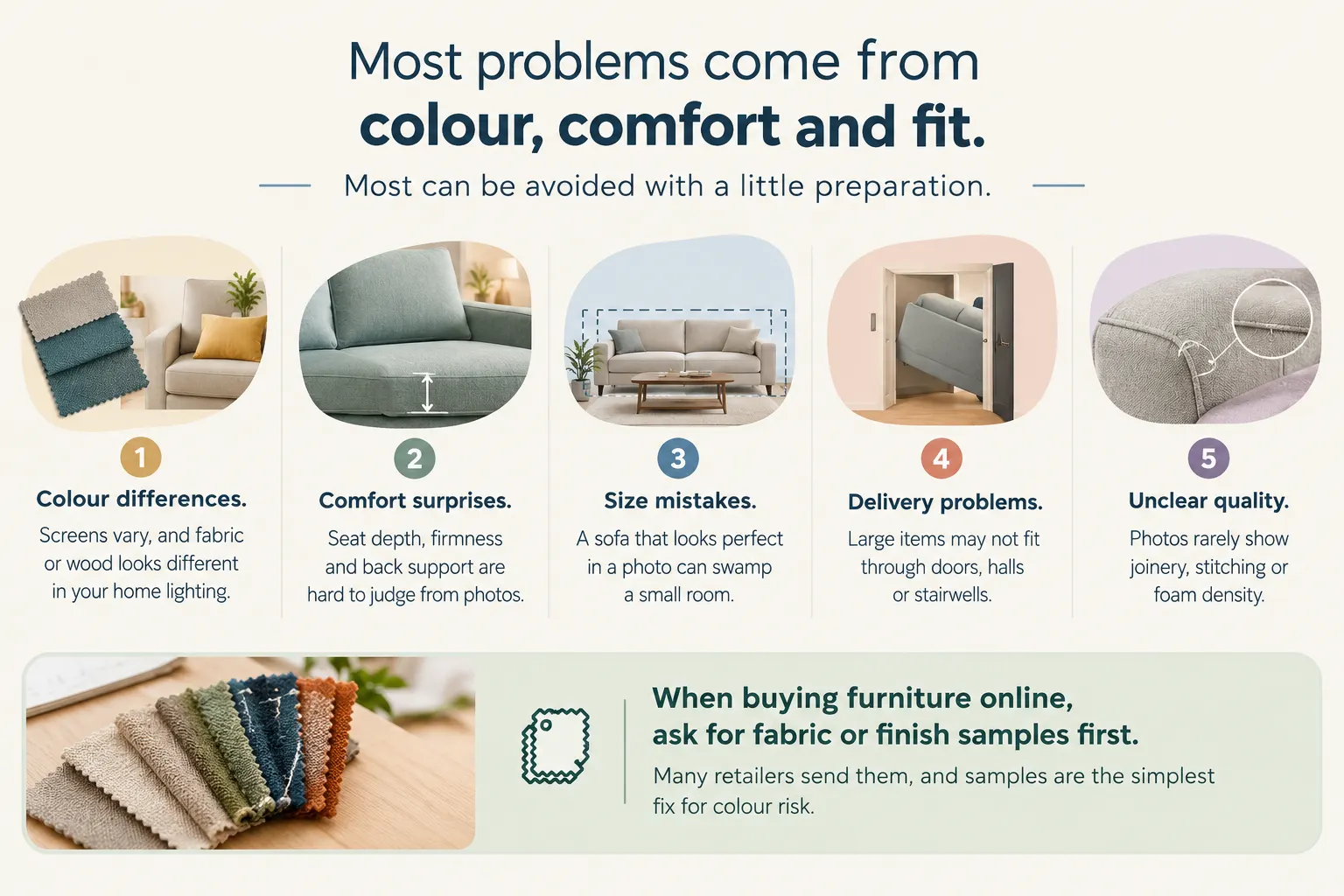
Most problems come from colour, comfort and fit. Most can be avoided with a little preparation.
Your consumer rights: online vs in-store furniture purchases
This is where the two routes differ most. The rules below apply in the UK. Check the current GOV.UK or Citizens Advice guidance for your case.
If you buy online
Online, phone and mail-order purchases fall under the Consumer Contracts Regulations 2013.
- You usually have 14 days from delivery to cancel your order.
- You then have another 14 days to send the goods back.
- The retailer must refund you once it has the goods, or proof you’ve sent them.
Two exceptions catch people out:
- Made-to-measure and personalised items are usually excluded. That can include custom sofas, bespoke tables and special-order fabrics.
- Sealed items such as mattresses can be excluded once you’ve opened the wrapping, for hygiene reasons.
Check both before you order.
If you buy in store
Cancellation rights do not automatically apply in every case. Some shops offer goodwill returns, but that’s their own policy, so ask before you pay.
The same goes if you buy in the shop and arrange delivery to your home. The 14-day online right doesn’t apply.
If the furniture is faulty (online or in store)
The Consumer Rights Act 2015 covers both. Goods must be of satisfactory quality, fit for purpose and as described.
- You usually have 30 days to return faulty items and request a refund.
- After that, you can usually ask for a repair or replacement.
- In the first six months, the seller generally has to prove the fault wasn’t there at delivery.
- Claims can be brought for up to six years in England, Wales and Northern Ireland, and five in Scotland.
If a dispute remains unresolved, Citizens Advice can guide you on what to do next. If the retailer is a member, the Furniture Ombudsman is another route.
For a full walk-through of claims, assembly and returns, read our guide to warranty, assembly and returns in the UK.
What should you check about furniture warranty?
A furniture warranty is extra cover from the maker or seller. It doesn’t replace your legal rights.
Before you buy, check:
- Length of cover. Frames often get longer cover than fabric, cushions or mechanisms.
- Exclusions. Wear and tear, stains and misuse are commonly left out.
- Who handles claims. It could be the retailer or the manufacturer.
- Your part. Some warranties need registration or a set care routine.
Keep your order confirmation and delivery note. They make any later claim much simpler.
How do you take furniture measurements before buying online?
Get your furniture measurements right and most online mistakes disappear. Start with your room measurements, then check every point on the route the piece has to travel.
Room measurements
- Measure the length and width of the room.
- Note windows, radiators, sockets and alcoves.
- Mark the piece’s footprint on the floor with masking tape.
- Leave room to walk. Many designers suggest about 75 to 90 cm for main walkways. Consider this a general guideline rather than a strict rule.
Door measurements
Delivery is where many online orders go wrong. Measure:
- The narrowest doorway on the route, using the frame opening
- Hallway width and any tight turns
- Stair width, ceiling height and banisters
- Lift size, if you live in a flat
Then compare these with the item’s width, depth, height and diagonal depth. Some sofas can be tipped on their side or have removable legs and arms. Ask whether the piece arrives assembled or in parts.
Queen size bed dimensions
“Queen” is a US size, and UK shops don’t always use it. Always check the exact mattress and frame sizes on the product page. A bed frame is bigger than the mattress inside it.

The nearest common UK size to a US queen is a king. Sizes can vary slightly by maker.
What happens with delivery, assembly and damage?
Delivery details matter almost as much as the furniture. Ask before you order.
- Delivery type. Find out if it’s kerbside, room of choice, or with assembly.
- Lead time. Made-to-order pieces can take weeks. Get the estimate in writing.
- Access. Send the retailer your door measurements and any stair or lift limits in advance.
- Return costs. Bulky items are expensive to send back. Check who pays.
If something arrives damaged:
- Inspect it while the delivery team is still there, if you can.
- Note any damage on the delivery paperwork.
- Take clear photos of the item and packaging.
- Contact the retailer in writing as soon as possible.
Under the Consumer Rights Act 2015, goods stay at the seller’s risk until they are in your possession. Reporting quickly still makes a claim easier.
How do you use online furniture reviews properly?
Read online furniture reviews for patterns, not star ratings.
- Start with the three-star reviews. They tend to be the most balanced.
- Look for comments on delivery, assembly and service, not just looks.
- Prefer reviews that say how long the piece has been in use.
- Check independent review sites as well as the retailer’s own pages.
- Be wary if many reviews use nearly identical wording.
For premium pieces, also look for construction details. Terms like solid wood frame, kiln-dried timber, high-resilience foam and full-grain leather should be backed by specifications, not just marketing copy.
Which furniture is safest to buy online, and what should you test in store?
Usually fine to buy online
- Coffee tables and side tables
- Bookcases and shelving
- Sideboards and consoles
- Lighting and mirrors
- Rugs (order a sample first)
Better to test in store first
- Sofas and armchairs
- Mattresses
- Dining chairs
- Office chairs
- Recliners
A simple rule works: if comfort is the point, test it. If style and size are the point, online is usually fine.
The best of both: research online, test in the showroom
For bigger purchases, mixing both routes works best. It suits people furnishing a new home, families upgrading a living room, and landlords fitting out several properties.
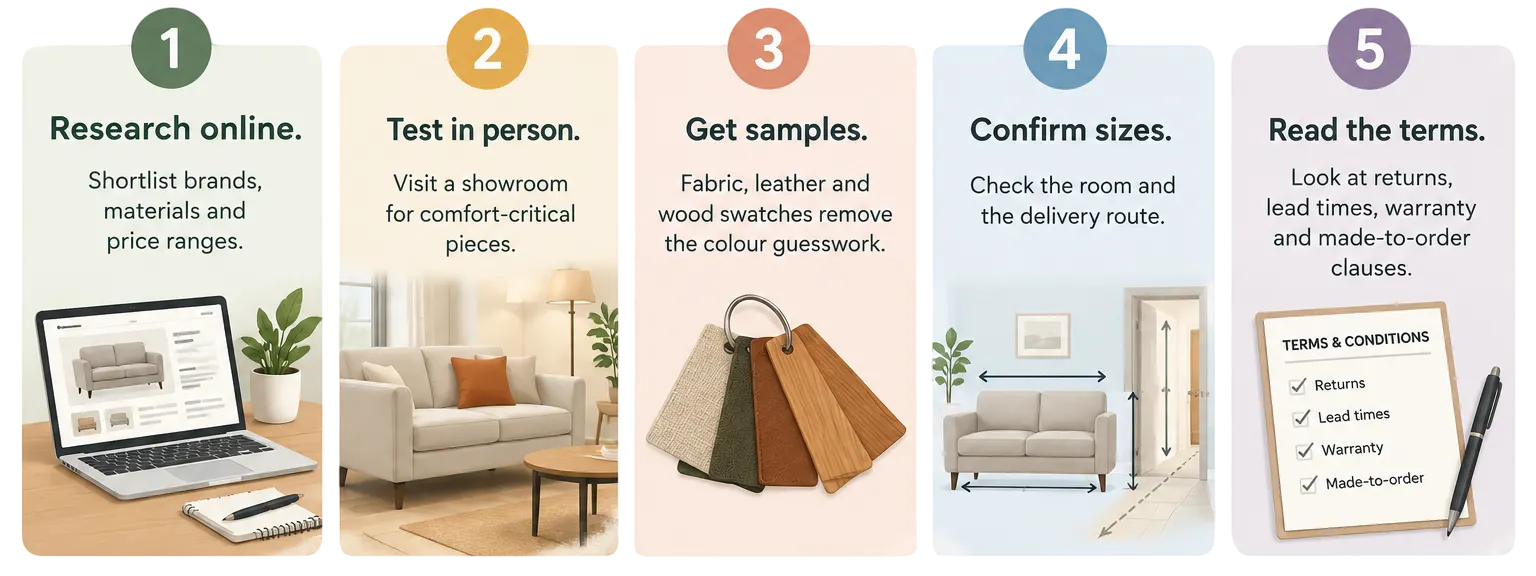
Colours often look different under showroom lights than at home. If you like a fabric, ask to take a swatch back and check it in daylight.
Try before you buy in Thurrock
If you’re near Lakeside, you can see our range in person at Unit 4, West Thurrock Retail Park, Thurrock, RM20 3LP. Sit on a few sofas, check a dining set against the size of your room, or try a mattress before you order.
We offer home delivery with free assembly, price match on stock products, and 0% finance for set periods. Ask our team for current terms.
Not sure where to start? Contact us and we’ll help you shortlist. Furnishing a whole home? Our new home furniture checklist is a good next read.
Online furniture shopping UK checklist
- Product size checked against your room
- Door, hallway and stair widths confirmed
- Fabric or finish sample requested
- Return and cancellation policy read
- Made-to-order items identified
- Warranty terms understood
- Delivery type and lead time confirmed in writing
- Independent reviews checked
- Payment method considered. A credit card can add Section 75 protection for a single item costing £100 to £30,000.
Key takeaways
- Neither route wins every time. Online is best for range and easy price checks. A shop is best for comfort, true colour and scale.
- Test in person: sofas, armchairs, mattresses, dining chairs and recliners. Usually fine to order online: tables, shelving, sideboards, lighting and mirrors.
- Online orders: you normally have 14 days after delivery to cancel, then 14 more to send the goods back. Made-to-measure items and opened mattresses are usually excluded.
- Shop purchases: there’s no automatic right to change your mind, even if you arrange home delivery. Faulty goods are covered by the Consumer Rights Act 2015: 30 days to reject, and six months in which the seller must prove the fault wasn’t there.
- Measure before you order. Check the room, the narrowest doorway, hallways and stairs, then compare them with the item’s width, depth, height and diagonal depth.
- “Queen” is a US bed size of about 152 × 203 cm. The nearest common UK size is a king at 150 × 200 cm.
- A warranty is extra cover. It doesn’t replace your legal rights.
- Read reviews for patterns, not star ratings. Start with the three-star ones.
- The safest approach for big purchases: research online, test in a showroom, take home a swatch, then check the terms before you pay.
Final thoughts
Buying furniture online vs in store isn’t a contest. Use online for range, comparison and spec detail. Use a showroom for comfort, scale and true colour.
If you’re furnishing a home or buying pieces to last, take your time, measure twice and read the terms. A few checks before you pay usually save far more than they cost.
Frequently asked questions
1. Is it cheaper to buy furniture online or in store?
Neither is always cheaper. Online makes prices easier to compare, but delivery, assembly and return costs can change the final price. Compare the total cost, including delivery and assembly, before you decide.
2. Can I return furniture bought online in the UK?
Yes, in most cases. Under the Consumer Contracts Regulations 2013, you can cancel an online furniture order within 14 days of delivery, then you have 14 more days to send it back. Made-to-measure items and opened mattresses are usually excluded.
3. Can I return furniture bought in store?
Not automatically. UK law gives no right to change your mind after buying in a shop, so it depends on the shop’s own returns policy. If the furniture is faulty, the Consumer Rights Act 2015 lets you reject it within 30 days for a refund.
4. How do I know if furniture will fit through my door?
Measure the narrowest doorway, the hallway, the stairs and any tight turns. Then compare them with the item’s width, depth, height and diagonal depth. If the fit is close, ask the retailer whether the piece can arrive in parts or with removable legs and arms.
5. What are the queen size bed dimensions in the UK?
A queen bed is a US size of about 152 × 203 cm, and it isn’t a standard UK size. The nearest common UK size is a king at 150 × 200 cm. Always check the exact mattress and frame sizes on the product page.
6. Is a warranty the same as my legal rights?
No. A warranty is extra cover from the maker or seller. The Consumer Rights Act 2015 applies alongside any warranty, and a warranty can’t take those rights away.
7. Are online furniture reviews reliable?
They can be, if you read them for patterns instead of star ratings. Look for repeated comments on quality, delivery and service, and cross-check with independent review sites. Be wary of many reviews with near-identical wording.
8. How do I choose between online furniture retailers UK buyers can trust?
Pick a retailer with clear specifications, fair return terms, genuine customer feedback and good aftercare, not just the lowest price. Check for a UK address, contact details and clear delivery and returns pages. Membership of the Furniture Ombudsman is a useful trust sign.
9. Is it safe to order furniture online in the UK?
Yes, if you use a trusted retailer and a protected payment method. Check the contact details, returns terms and reviews first. Paying by credit card adds Section 75 cover on single items costing £100 to £30,000.
10. Who pays to return furniture bought online?
Usually the buyer pays return delivery, unless the retailer agrees to cover it or didn’t tell you about the charge. If the furniture is faulty, the retailer must cover reasonable return costs under the Consumer Rights Act 2015.
11. Which furniture should I test in a shop first?
Test sofas, armchairs, mattresses, dining chairs, office chairs and recliners, because comfort is hard to judge from photos. Tables, shelving, sideboards, lighting and mirrors are usually fine to order online.
12. Can I cancel a furniture order before it arrives?
Yes, for most online orders. You can cancel from the moment you order until 14 days after delivery under the Consumer Contracts Regulations 2013. Made-to-measure and personalised items are usually excluded.