




Why Is My Sofa Sagging? Common Causes and What You Can Do

Why is my sofa sagging? Because something inside it has worn out. Most often, it’s the cushion foam that has lost its bounce. It can also be tired springs, stretched webbing, or a weak frame.
Some softening is normal as a sofa gets older. Sagging in the first year or two is not. That usually points to cheap materials or a weak build.
This guide helps you:
- Find out what’s causing the sag
- Pick the right fix
- Decide whether to repair or replace
Quick answer: causes and fixes

What causes a sofa to sag?
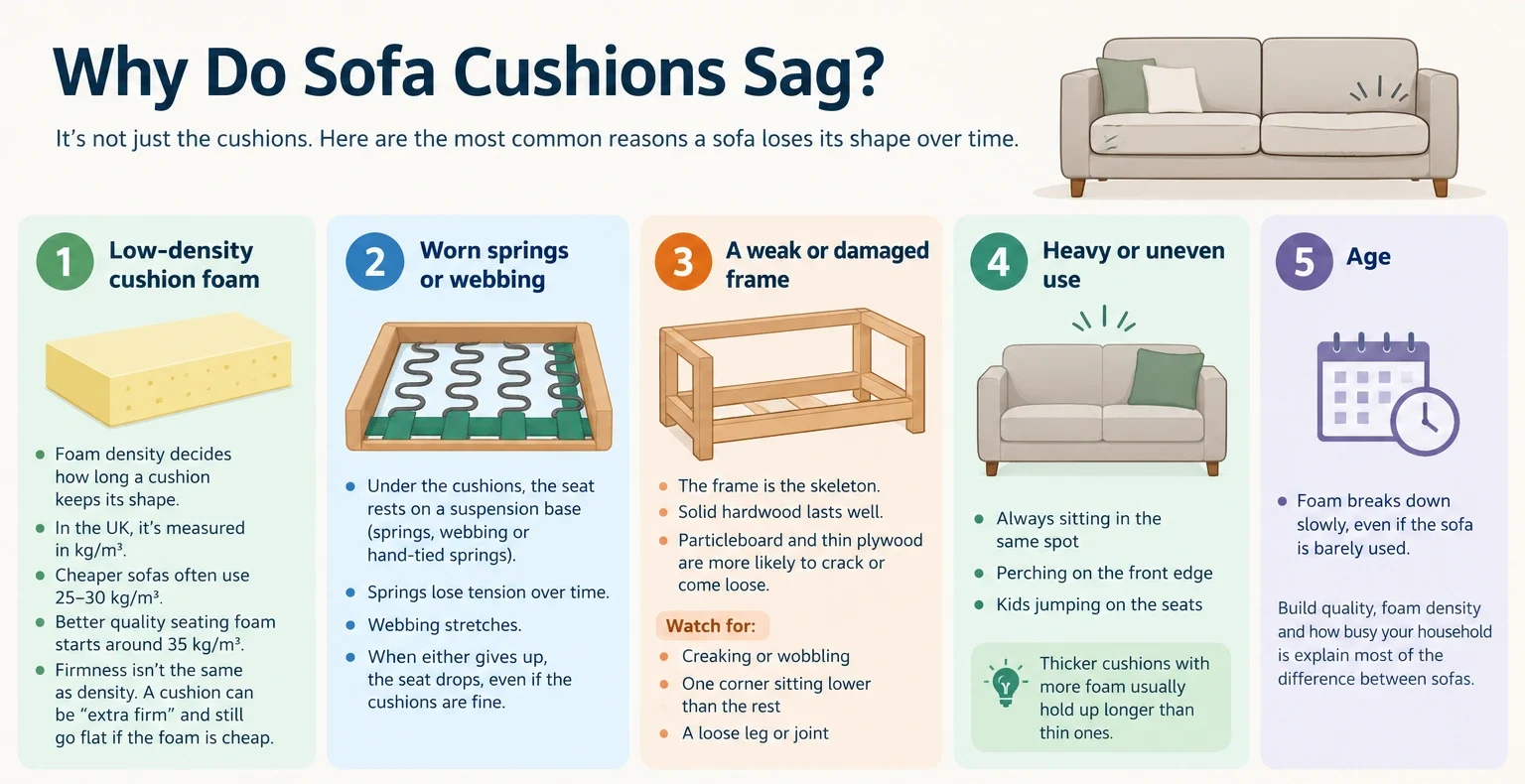
1. Low-density cushion foam
This is the top reason for sofa cushions sagging. Foam density decides how long a cushion keeps its shape.
- In the UK, density is measured in kg/m³.
- Cheaper sofas often use foam at roughly 25-30 kg/m³.
- Better seating foam usually starts around 35 kg/m³.
- Firmness is not the same thing as density. A cushion sold as “extra firm” can still go flat quickly if the foam is cheap.
2. Worn springs or webbing
Under the cushions, the seat rests on a suspension base. That’s usually sinuous (zig-zag) springs, elastic webbing, or hand-tied springs in traditional sofas.
- Springs lose tension over time.
- Webbing stretches.
- When either gives up, the seat drops, even if the cushions are fine.
3. A weak or damaged frame
The frame is the skeleton. Solid kiln-dried hardwood lasts well. Particleboard and thin plywood are more likely to crack or come loose.
Watch for:
- Creaking or wobbling
- One corner sitting lower than the rest
- A loose leg or joint
4. Heavy or uneven use
Small habits add up.
- Always sitting in the same spot
- Perching on the front edge
- Kids jumping on the seats
Thicker cushions with more foam underneath them usually hold up longer than thin ones.
5. Age
Foam breaks down slowly, even if the sofa is barely used. Build quality, foam density and how busy your household is explain most of the difference between sofas. See the sofa lifespan section below for rough ranges.
Is it the foam or the springs? A 2-minute test
 You can narrow it down at home.
- Take off the seat cushion.
- Press down firmly on the base underneath.
- Sit on the bare base for a few seconds.
- Compare what you feel with the table.

This is only a home check. An upholsterer can confirm the cause before you spend money.
Why is my sofa sinking on one side or in the middle?
If your sofa is sinking, look at who sits where. Most homes have a favourite seat, and that cushion does most of the work.
Sinking on one side
- Swap cushions between seats if they’re the same size.
- Rotate who sits where.
- If it keeps sinking, check the springs and frame under that seat.
Sinking in the middle
- The centre seat often gets the most use.
- The foam may be squashed, or the springs below may have loosened.
- Run the 2-minute test on that seat first.
How to fix a sagging sofa
 If you’re wondering how to fix a sagging sofa, start with the cheapest option and work up.
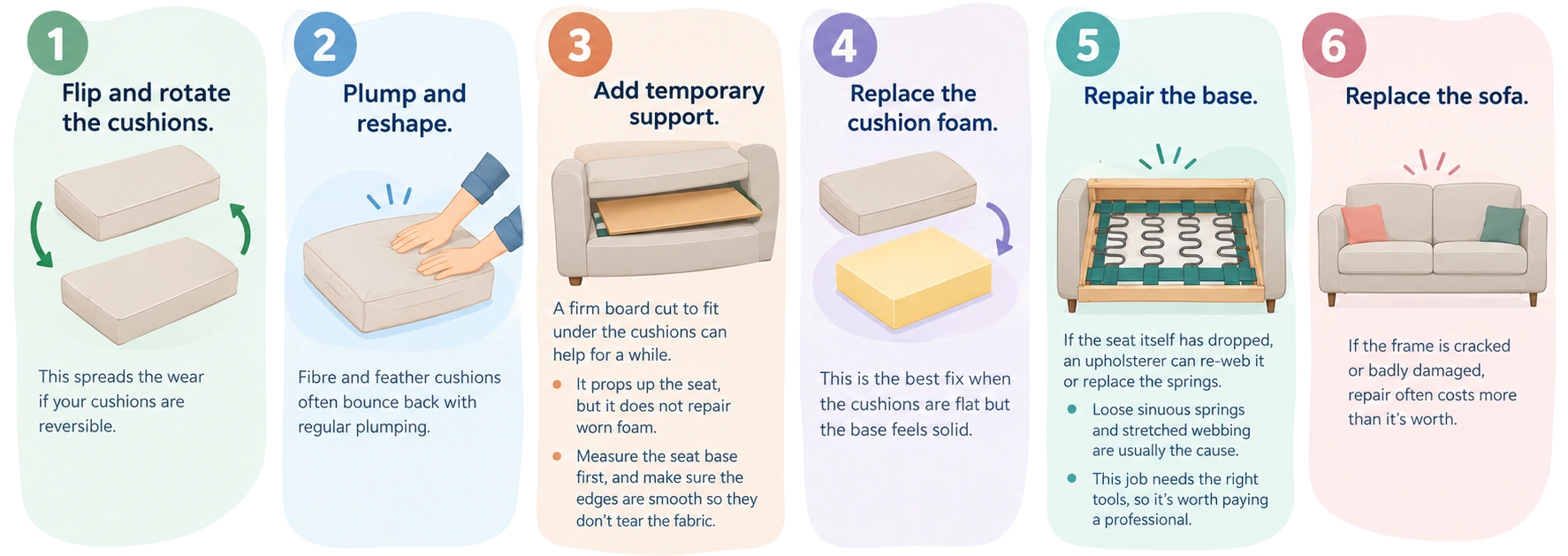
- Flip and rotate the cushions. This spreads the wear if your cushions are reversible.
- Plump and reshape. Fibre and feather cushions often bounce back with regular plumping.
- Add temporary support. A firm board cut to fit under the cushions can help for a while.
- It props up the seat, but it does not repair worn foam.
- Measure the seat base first, and make sure the edges are smooth so they don’t tear the fabric.
- Replace the cushion foam. This is the best fix when the cushions are flat but the base feels solid.
- Repair the base. If the seat itself has dropped, an upholsterer can re-web it or replace the springs.
- Loose sinuous springs and stretched webbing are usually the cause.
- This job needs the right tools, so it’s worth paying a professional.
- Replace the sofa. If the frame is cracked or badly damaged, repair often costs more than it’s worth.
Sofa cushion replacement: what to know
Sofa cushion replacement is often the most cost-effective fix. A specialist cuts new foam to match your old cushions, and you keep the original covers.
When choosing new foam:
- Pick high-resilience (HR) foam for everyday seating. It bounces back better and is usually the denser grade.
- Match the thickness of the old cushion.
- Ask about a fibre or feather wrap if you want a softer look.
- Give the supplier your cover measurements, not only the old cushion size.
- Ask them to confirm the foam meets UK fire safety rules.
Sofas sold in the UK must follow the Furniture and Furnishings (Fire) (Safety) Regulations 1988, and replacement filling should meet them too. Our guide to UK furniture fire safety regulations explains what the fire label means.
Cost: [ADD: 2–3 real UK quotes for foam refill per cushion, with the date you got them.]
Should you repair or replace a sagging sofa? 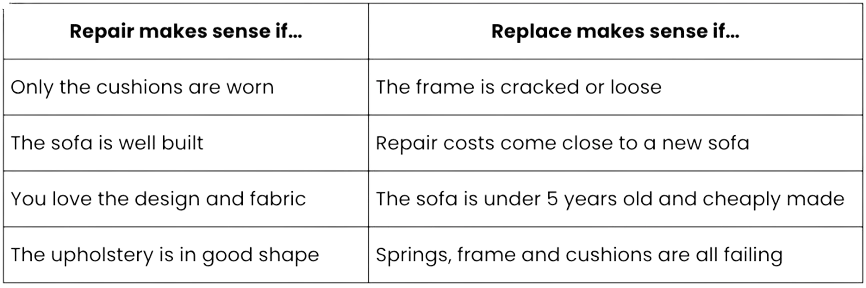
Sofa repair in the UK: who does what
Sofa repair in the UK is mostly done by independent upholsterers. Many also cover general furniture repair UK-wide, not just sofas.
A good sofa upholstery UK service can:
- Re-foam cushions
- Re-web or re-spring a base
- Recover a frame
Leather needs a specialist for cracks, tears or worn patches. If you’re in the capital, a search for leather sofa repair London will show firms that match colours and repair hides. Anywhere else, add your town or county to the search.
Before you book:
- Ask for a written quote
- Ask to see photos of past jobs
- Check they’ve worked on your type of sofa
Sofa lifespan: how long should a sofa last?
Sofa lifespan depends mostly on build quality. These are rough ranges, not promises.
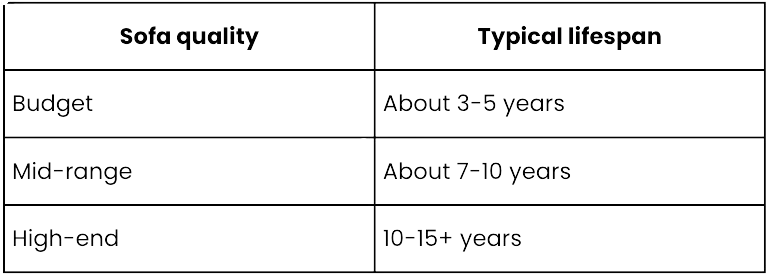 A well-kept mid-range sofa can outlast a neglected premium one.
Budget sofas tend to wear out sooner because of lighter frames, low-density foam and basic springs.
Sagging after only a year or two?
The Consumer Rights Act 2015 says goods must be of satisfactory quality and last a reasonable time. In broad terms:
- First 30 days: you can usually reject a faulty sofa.
- First 6 months: the seller has to prove the fault wasn’t there when it arrived.
- After 6 months: you may still have a claim, but you’ll need to show the fault was there from the start.
Keep your receipt and take photos. Check the exact rules on gov.uk or with Citizens Advice. Our post on furniture warranty in the UK covers more.
How to prevent sofa cushions sagging
Good sofa maintenance only takes a few minutes a week.
- Rotate and flip cushions every week or two
- Change who sits where
- Plump fibre and feather cushions regularly
- Avoid sitting on the arms or front edge
- Keep the sofa away from direct sun and radiators
- Vacuum under and between the cushions to clear grit
- Tighten loose legs and joints early
What to look for in a sofa that won’t sag
If your last sofa gave up early, use it as a checklist for the next one.
| Part | What to look for |
| Frame | Solid kiln-dried hardwood |
| Suspension | Well-tensioned springs, such as eight-way hand-tied or good sinuous springs |
| Cushions | HR foam, ideally wrapped in fibre or feather |
| Joints | Glued, screwed and corner-blocked, not only stapled |
| Guarantee | A clear frame guarantee and stated cushion terms |
These hidden parts are where better-made sofas usually spend the extra money, and it shows in how long they keep their shape.
At Designer Furniture Gallery, you can browse our fabric sofas and ask our Thurrock team about the frame, foam and guarantee on any model. You can also read our guide to choosing a sofa [link to be confirmed] to compare construction, fabrics and comfort.
Frequently asked questions
- Why is my sofa sagging after only a year or two?
Usually low-density foam or a weak base. Check your warranty, because some retailers cover early cushion failure. Your consumer rights may also apply.
- Can you fix sofa cushions that are sagging?
Yes. Plumping, refilling or replacing the foam can bring them back. Replacing the foam lasts longest.
- How do I fix a sagging sofa base?
A sagging base needs new webbing or springs. An upholsterer can do this without replacing the whole sofa.
- How much does sofa cushion replacement cost in the UK?
It depends on cushion size, foam grade, and whether you add a feather wrap. Get written quotes from at least two upholsterers or foam suppliers. [ADD: verified UK price range from real quotes.]
- Why is my sofa sinking in the middle?
The middle seat often gets the most use. The foam may be squashed, or the springs below may have loosened.
- How long should a sofa last?
Most last around 7 to 15 years, depending on build quality. Budget sofas may last much less, and well-made ones can last longer with good care.
- Is it worth repairing an old sofa?
Yes, if the frame is solid and the sofa is well made. Rarely, if the frame is cracked or the sofa was built cheaply.
- Can leather sofas be repaired?
Yes. Leather specialists can re-foam cushions, re-web bases, and fix tears or cracking. Ask to see examples of their colour-matching work.
Final thoughts
A sagging sofa isn’t always the end of the road. If the frame is sound, new cushion foam or a base repair can give it years more life.
If the sofa is cheaply built or the frame has failed, a well-made replacement is the better long-term buy.