



UK Furniture Fire Safety Regulations Explained: What “Fire Label” Compliance Actually Means

The furniture fire safety regulations UK are legal rules that control how upholstered furniture is made, tested, and labelled. They are officially called the Furniture and Furnishings (Fire) (Safety) Regulations 1988, and every sofa, armchair, and upholstered bed sold in the UK must meet them. In simple terms, these rules stop dangerous furniture from ever reaching your living room.
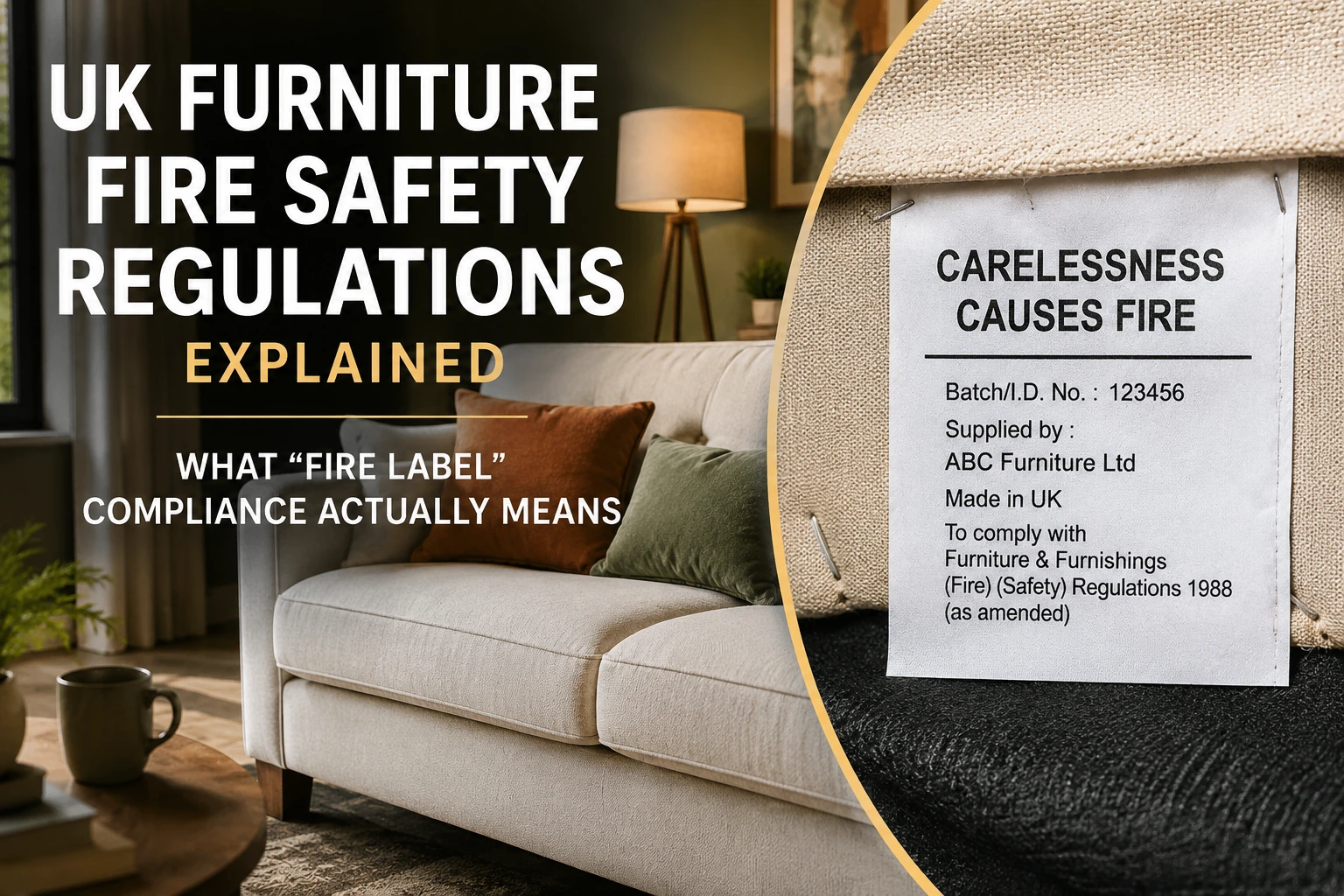
If you’ve ever flipped over a sofa cushion and spotted a white label with the words “CARELESSNESS CAUSES FIRE,” you’ve already seen this law in action. That label is not decoration. It’s proof the furniture passed strict flammability testing before it left the factory.
This guide breaks down what fire label compliance really means, why it matters when you’re buying premium furniture, and what’s changing in 2026.
Why the fire safety regulations exist
Before 1988, most UK sofas were filled with plain polyurethane foam. This foam ignited fast and produced thick, toxic smoke. Government research later confirmed the risk: in the years before the regulations, furniture caused roughly 7.5% of house fires in England and Wales, yet accounted for around 35% of all fire deaths (Department of Trade and Industry, Effectiveness of the Furniture and Furnishings (Fire)(Safety) Regulations 1988, 2000).
That imbalance pushed the government to act. Once the regulations came into force, the results were measurable. By 1997, the same study found the rules had saved an estimated 710 lives in under a decade.
This history matters because it explains why fire safety regulations UK-wide remain so strict today, even as the rules themselves are being modernised.
The five core requirements every compliant sofa must meet
Under the current Furniture and Furnishings (Fire)(Safety) Regulations 1988 (as amended), manufacturers and importers must meet five requirements:
- Filling materials must pass specified ignition tests, whether foam, feather, or fibre.
- Upholstery composites (the fabric plus filling together) must resist a lit cigarette.
- Covers must resist a lit match, or be paired with a match-resistant interliner.
- A permanent label must be fitted to almost every new item of furniture.
- Records must be kept for five years by the first UK supplier, proving the product was tested and traceable.
Every genuine fire-resistant furniture item sold in the UK, from a budget armchair to a designer leather sofa, has to clear all five of these hurdles.
What does the fire safety label on a sofa actually mean?
A fire safety label on a sofa is legal proof that the item passed the cigarette and match ignition tests required by UK law. It’s not a marketing sticker. It’s a compliance document sewn or stapled directly onto the furniture.
The permanent label
The permanent label is the one you’ll actually find on your furniture. Look for it:
- Under a loose seat cushion
- On the underside of the frame
- Stitched into a hidden seam at the back
It should include the phrase “CARELESSNESS CAUSES FIRE,” along with a batch number and manufacturer or importer details. This information lets Trading Standards trace the item back to its supplier if a safety issue is ever raised.
The display label (recently removed)
Until October 2025, furniture also had to carry a separate display label, usually a swing tag, showing test results at the point of sale. The Furniture and Furnishings (Fire)(Safety) (Amendment) Regulations 2025 removed this requirement for new products, while keeping the permanent label rule fully in place. So if a modern sofa doesn’t have a swing tag, that’s not automatically a red flag. The permanent label is what still matters legally.
How fire-resistant furniture is actually tested
Furniture doesn’t become “fire safe” by guesswork. Each component goes through defined laboratory tests before a product can legally be sold.

Manufacturers test finished combinations, not just individual fabrics. A cover fabric that passes on its own can still fail once paired with a different foam, which is why compliance sits with the finished product, not a single material.
Mattress fire safety labels: how they’re different
A mattress fire safety label follows a separate British Standard rather than the main furniture regulations. Mattresses, divans, and bed bases are covered by BS 7177: Specification for Resistance to Ignition of Mattresses, Mattress Pads, Divans and Bed Bases.
Key differences to know:
- Mattresses don’t carry the “CARELESSNESS CAUSES FIRE” permanent label used on sofas.
- Instead, look for a label referencing BS 7177 and a stated ignition resistance level (domestic, contract, or crib 5).
- Contract-grade mattresses, built for hotels and care homes, must meet a higher ignition resistance standard than standard domestic mattresses.
If you’re furnishing a rental property or guest suite, checking for the correct BS 7177 rating matters just as much as checking a sofa’s fire label.
2025 amendment and the 2026 consultation: what’s changing
UK furniture fire safety regulations are currently being modernised for the first time in over 35 years. Two changes are worth knowing about.
Already in force (October 2025):
- Certain baby and young children’s products, such as small mattresses and cot upholstery, were removed from scope.
- The display label requirement for new furniture was dropped.
- Enforcement bodies now have 12 months, instead of six, to bring legal proceedings against non-compliant sellers.
Under consultation (closed June 2026):
- Proposals to reduce reliance on chemical flame retardants in furniture foam and fabric.
- A new smoulder-based test method, designed to cut toxic smoke risk without relying as heavily on chemical treatments.
- Clearer scope rules for upholsterers and second-hand furniture sellers.
The core safety principle isn’t changing. The goal is to keep furniture fire-resistant while reducing dependence on flame-retardant chemicals linked to health and environmental concerns. Retailers and buyers should expect updated British Standards to follow the consultation, likely phased in with a transition period.
New vs. second-hand furniture: compliance compared

Second-hand furniture is not exempt from these rules. If you’re buying a pre-owned sofa without a permanent label, that’s a genuine compliance gap, not just a cosmetic issue.
How to check if furniture is fire safety compliant before you buy
Reading fire safety labels for furniture correctly takes less than a minute once you know what to look for. Before buying a sofa, armchair, or upholstered bed, run through this quick checklist:

This last point matters more than many buyers realise. UK trading standards bodies regularly intercept imported sofas at the border for missing or invalid fire labels, and non-compliant stock has been destroyed rather than allowed onto the market.
What happens if furniture doesn’t meet fire safety regulations?
Furniture that fails to meet UK fire safety regulations can be banned from sale, recalled, or destroyed, and the seller can face significant fines. Enforcement isn’t theoretical. Trading Standards authorities across the UK actively inspect furniture retailers, and penalties have included fines approaching £20,000 for labelling breaches alone, separate from any fine linked to an actual product failure.
For homeowners, the risk isn’t just legal. Non-compliant filling and cover materials ignite faster and burn more aggressively, giving occupants far less time to escape a fire that starts on or near furniture.
Why this matters when choosing premium and designer furniture
Luxury furniture buyers sometimes assume a higher price automatically means higher safety. That’s not guaranteed. Genuinely fire resistant furniture meets the same legal minimum whether it’s a budget sofa or a designer leather chesterfield.
What premium furniture should offer on top of basic compliance:
- Fillings and fabrics tested together as a finished product, not just individually rated components
- Clear, accessible documentation from the retailer on request
- Materials selected with both durability and fire performance in mind, since higher-density foams and natural fillings often behave differently under flame testing
When furnishing a new home, upgrading a living space, or fitting out a rental property, checking for a valid permanent label takes seconds and confirms the product meets UK law, regardless of how premium the price tag looks.
The bottom line
UK furniture fire safety regulations exist to make sure every upholstered item in your home can resist ignition from everyday hazards like cigarettes and matches. The permanent fire label is your quickest way to confirm compliance, whether you’re buying new, second-hand, or upgrading to premium designer pieces. With reforms already underway and more expected following the 2026 consultation, checking for that label will remain the simplest, most reliable step any buyer can take before furnishing a home.
Looking for fire-safety compliant furniture backed by full manufacturer documentation? Browse our designer sofa collection or get in touch with our team for compliance details on any piece in our showroom.
Frequently asked questions
- Is it illegal to sell furniture without a fire label in the UK?
Yes. Selling new or second-hand upholstered furniture without a valid permanent fire safety label breaches the Furniture and Furnishings (Fire)(Safety) Regulations 1988. Sellers can face fines, sale bans, or product seizure.
- Do all sofas in the UK need a fire safety label?
Almost all upholstered sofas need a permanent fire safety label. A small number of exceptions exist, such as furniture made before 1950 or certain export-only goods, but standard domestic sofas sold in the UK must carry one.
- What does “CARELESSNESS CAUSES FIRE” mean on a sofa label?
It’s the required heading on the permanent compliance label fitted to UK furniture. Its presence, along with a batch number and supplier details, confirms the item passed the mandatory cigarette and match ignition tests.
- Are mattresses covered by the same fire safety label as sofas?
No. Mattresses follow British Standard BS 7177 rather than the sofa-style permanent label. Look for wording referencing BS 7177 and an ignition resistance rating instead.
- Can I still buy second-hand furniture legally in the UK?
Yes, but it must meet the same fire safety standards as new furniture and should still carry its original permanent label. Sellers who cannot show valid labelling risk breaching the regulations.
- What’s changing with UK furniture fire regulations in 2026?
Following a 2025 amendment that removed display labels and adjusted scope for baby products, a 2026 government consultation is reviewing further changes, including reduced reliance on chemical flame retardants and a new smoulder-based test method.
- Does a higher price mean furniture is more fire resistant?
Not automatically. Fire safety compliance is a legal minimum every retailer must meet, regardless of price. Premium furniture should still be checked for a valid permanent label and clear compliance documentation.
- Where is the fire safety label usually located on a sofa?
Most commonly under a loose seat cushion, stitched into a rear seam, or attached to the base of the frame. If it isn’t visible, ask the retailer to confirm compliance directly.